

September 7, 2026
The Event Planner’s Production Playbook: 10 Decisions That Make Show Day Feel Calm
Show Gear Productions
A calm show day starts long before load-in. This practical production playbook walks event planners through 10 decisions—from goals, audience needs, and venue constraints to rehearsals, contingencies, and show-day authority—that create a more predictable event production process.
There is a particular kind of calm you notice at a well-produced event.
The doors open on time. Presenters know where to go. Videos roll when they should. Lighting changes support the moment rather than distract from it. The audience hears every word. When something unexpected happens—and something almost always does—the response is quick, quiet, and controlled.
That calm is rarely the result of having more equipment.
It is the result of making the right decisions early.
For event planners, this is one of the most useful ways to think about production. Before discussing LED walls, microphones, lighting fixtures, scenic elements, or camera packages, establish the operating framework for the event itself. Those decisions give your production partner the information needed to recommend the right solution rather than simply assemble a list of gear.
At Show Gear, that philosophy starts with thinking like a planner. The company has former event planners on staff who have managed association meetings, corporate conferences, and multi-day programs from the planner side of the table. Its process begins with event goals, audience, and vision before moving into design and technical planning.
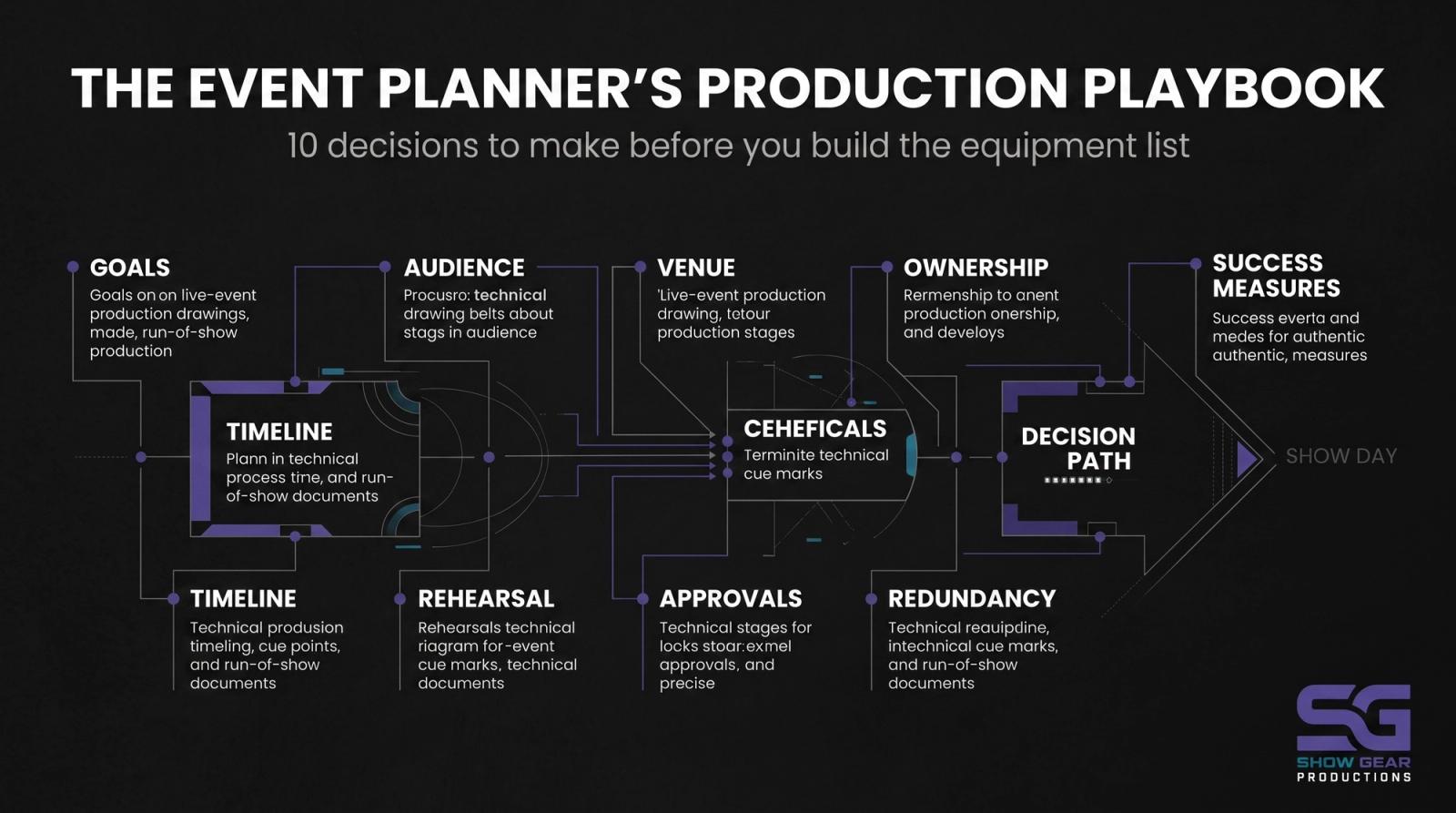
For planners, the following ten decisions create the foundation for a more predictable production process—and a much calmer show day.
Define What the Event Has to Accomplish
Start with the outcome, not the room.
What should attendees know, feel, believe, or do differently when the event is over?
A leadership meeting designed to build confidence in a new strategy requires different production choices than an awards gala intended to create celebration and emotional impact. A product launch built around a dramatic reveal has different priorities than an association conference focused on education and networking.
When the objective is clear, production decisions become easier to evaluate. Instead of asking, “Would a larger screen look better?” you can ask, “Would a larger visual environment help this audience understand and engage with the content?”
That distinction protects both the creative vision and the budget.
Understand the Audience Experience
Planners naturally think about attendees, but production planning should go deeper than expected headcount.
Where will people sit? How far is the last row from the stage? Are attendees primarily watching presentations, participating in discussions, celebrating achievements, or moving between experiences? Will remote participants be involved? Does the audience include people who may require assisted listening, captioning, or other accessibility considerations?
Consider the event from the attendee’s physical point of view.
Can someone in the back of the room read the presentation? Can everyone hear a soft-spoken panelist? Will cameras or scenic elements block sightlines? Does the lighting make the stage feel engaging while still allowing attendees to take notes?
Production becomes more effective when every technical decision can be connected to an audience need.
Identify Venue Constraints Before Design Gets Too Far
A beautiful concept that cannot be built efficiently in the selected venue is not a successful concept.
Before production plans become highly developed, understand the room’s realities. Ceiling height, rigging availability, loading access, power, stage dimensions, fire-code requirements, labor rules, internet infrastructure, elevator dimensions, sound restrictions, and available setup time can all affect the final approach.
Even seemingly small factors matter. A ballroom with limited loading access may require a different scenic strategy. A low ceiling may change lighting positions. A room with significant ambient daylight can influence projection or display choices.
The goal is not to let constraints kill creativity. It is to incorporate those constraints early enough that the creative team can design intelligently around them.
Show Gear formalizes this progression by moving from discovery into design and then a comprehensive production plan covering staging, lighting, audio, video, logistics, and timeline.
Decide Who Owns What
Many show-day problems begin with a sentence that sounds harmless:
“I thought they were handling that.”
Clarify responsibilities before schedules become compressed.
Who owns presentation collection? Who approves scenic design? Who coordinates with the venue? Who manages speakers? Who supplies walk-in music? Who confirms videos are final? Who communicates changes to the production team?
For larger programs, build a simple responsibility matrix. It does not need to become a complicated project-management exercise. It simply needs to make clear who is responsible for each important deliverable and who has final approval.
Production works best when there is one identifiable owner for every critical decision.
Build the Timeline Backward From Doors Open
“Show starts at 8:00” is not a production schedule.
Work backward from the moment attendees enter the experience.
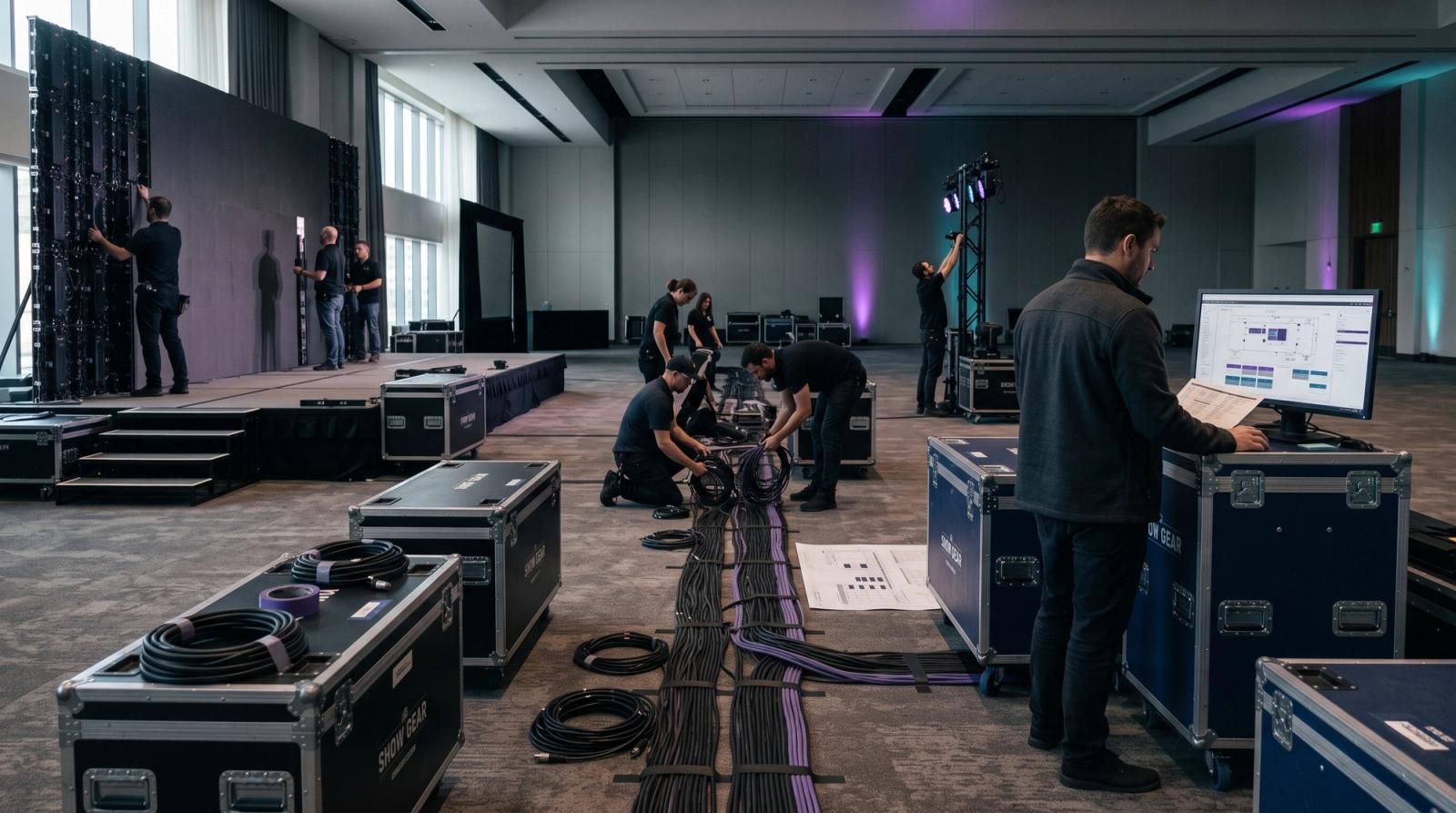
Before doors open, the room may need a final technical check, stage reset, presenter preparation, rehearsal, content testing, lighting focus, scenic installation, equipment setup, and load-in. Each activity depends on the one before it.
This is where planners can uncover risk early.
If the venue provides ballroom access at noon and the program starts at 5:00, a design requiring an eight-hour installation creates an obvious problem. Discovering that during planning allows the team to modify the design, negotiate earlier access, or adjust resources.
Discovering it on show day creates stress.
Protect Rehearsal Time
Rehearsal is often the first thing squeezed when an event schedule gets tight. It should be one of the last.
A useful rehearsal is not simply a speaker reading slides from the stage. It is the moment when content, people, technology, and timing finally meet.
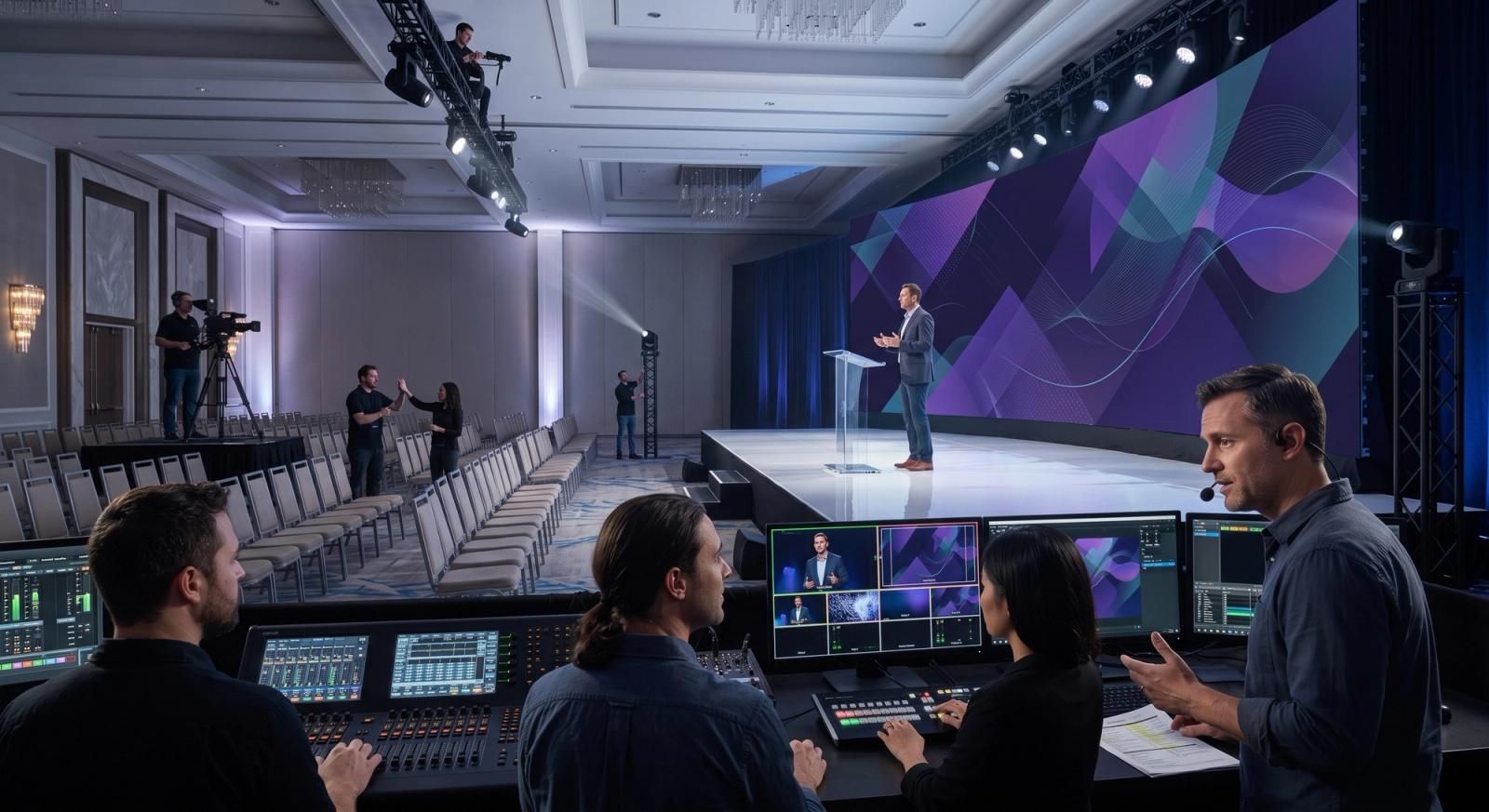
Speakers learn where to stand. Camera operators establish shots. Presentation operators confirm cues. Lighting looks can be refined. Walk-on music gets timed. Videos are tested with the actual show system. The producer can identify awkward transitions that were invisible on paper.
Show Gear’s execution model specifically includes a dedicated producer managing load-in, rehearsals, and the live show. That reflects an important production reality: rehearsal is part of execution, not an optional extra.
Establish an Approval Process
Production teams can move quickly when they know who can say yes.
Determine in advance who has authority to approve creative concepts, budgets, show graphics, technical changes, and last-minute decisions.
This becomes especially important when several stakeholders are involved. An event planner may be coordinating with executives, marketing teams, sponsors, agencies, venue representatives, and internal communications departments simultaneously.
Without a clear approval path, a simple decision can generate hours of email and conflicting direction.
Create deadlines for major approvals and identify the final decision-maker for each area. When possible, consolidate feedback before sending it to creative or production teams.
That keeps revisions purposeful and protects the schedule.
Decide Where You Need Redundancy
Not every component requires a backup. Critical ones often do.
Ask a simple question: “If this fails during the program, what happens next?”
If the answer is “the audience waits while we fix it,” consider a contingency.
Depending on the program, that could mean backup playback, spare microphones, redundant presentation computers, alternate internet connectivity, replacement media files, or a plan for what the emcee says if a segment has to be skipped.
Contingency planning is not pessimism. It is how experienced production teams preserve the audience experience when technology, timing, or people behave unpredictably.
Create a Show-Day Decision Path
Show day is the wrong time to determine who has authority.
Imagine a keynote is running twelve minutes long. Does the producer cut the following video? Shorten the break? Ask the moderator to reduce the panel discussion? Wait for the planner to locate an executive?
There should already be a decision path.
Identify the planner-side person empowered to make real-time calls and establish how that person communicates with the show producer. For complicated programs, define priorities in advance: which elements are protected, which can be shortened, and which can disappear entirely if the schedule slips.
This allows the production team to respond in seconds rather than convene a committee backstage.
Define What Success Looks Like After the Applause
Production planning should include the question planners sometimes save for later: How will we know this worked?
Success might involve attendee engagement, session participation, sponsor visibility, audience feedback, content retention, executive satisfaction, streaming metrics, or smooth execution against the run of show.
Defining those measures early can influence the experience itself.
It also gives planners and production teams something concrete to review afterward. Show Gear incorporates a post-event review into its process to identify what worked and what can be improved for the next event.
That creates institutional knowledge instead of forcing planners to reinvent the production process every year.
Calm Is Designed Before Show Day
The most confident event planners do not attempt to eliminate every surprise. Live events do not work that way.
They create a structure that makes surprises manageable.
Clear goals guide creative decisions. Audience needs inform production choices. Venue realities shape the design. Ownership eliminates confusion. A realistic timeline protects execution. Rehearsals expose problems while there is still time to solve them. Approval paths keep decisions moving. Contingencies protect critical moments. Show-day authority enables fast responses. Post-event review makes the next program stronger.
Only after those pieces are understood does it make sense to build the equipment list.
That is also why the first conversation with a production partner should rarely begin with, “How much equipment do we need?” A better starting point is, “Here is what this event needs to accomplish.”
Show Gear’s planner-first approach is built around that conversation: understand the goals, audience, and vision first, then design the production system around the experience. For planners trying to create more confidence and control before the next show, that may be the most important production decision of all.

Show Gear Productions
Show Gear Productions is a full-service event production company, delivering stage design, technical production, and AI-driven immersive experiences backed by more than three decades of industry expertise.
Ready to talk about your next event?
Start planning your next event. Our team is ready to bring your vision to life.