

August 17, 2026
Before the Room Fills Up: Inside a General Session Load-In
Show Gear Productions · Production Team
Most of what decides how a general session feels happens days before anyone walks in. Here is what is going on in an empty ballroom.
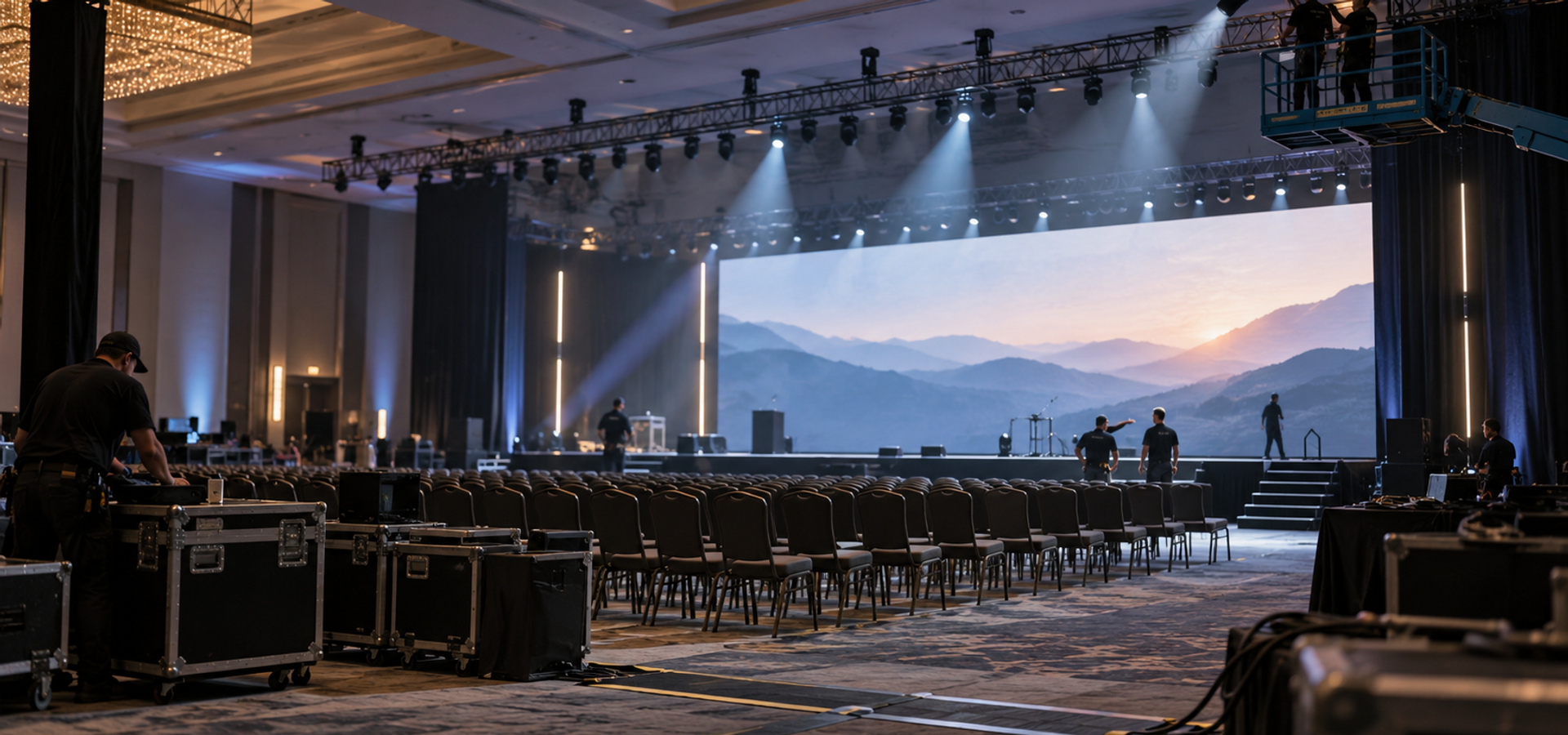
The ballroom is empty and the carpet is still taped down. Somewhere above the house, two techs are focusing a fixture that most of the audience will never consciously notice, and every one of them would feel if it were wrong.
By the time attendees walk into a general session, the show has already been built, broken, rebuilt and rehearsed. Here is what that looks like from the floor.
Load-in is a choreography problem, not a lifting problem
Trucks do not unload in the order the gear was packed. They unload in the order the room gets built. Rigging points go in before anything hangs from them. Audio needs the room quiet, which means it needs the scenic crew somewhere else. Video wall calibration wants the house lights down, which is the last thing a scenic carpenter wants.
A load-in schedule is really a sequencing document that keeps four or five trades from needing the same twenty feet of floor at the same moment. Get the sequence right and a big room comes together calmly. Get it wrong and you pay for it twice: in overtime, and in the quality of everything that happens after.
Rehearsal is where the show actually gets written
Speakers arrive with decks. They leave rehearsal with a show.
Rehearsal is where you find out that slide 14 has white text over a bright photo and disappears on a forty-foot wall. That your CEO paces, so the mic needs to be a headset and not a lav. That the video sting runs four seconds and the walk-on takes seven. That two presenters open with the same joke.
None of that shows up in a run-through on a laptop. All of it is obvious in the room. Teams that protect rehearsal time get better shows than teams that treat it as buffer to be spent when load-in runs long.
Redundancy is a design decision, not a shopping line
Anything that would stop the show gets a backup: playback, comms, the console, the feed to the recording. Anything that would merely be awkward gets a plan instead of a spare.
The useful question is not what could fail. Everything could. It is what fails silently. A dead wireless channel announces itself immediately. A recording that quietly stopped forty minutes ago does not, and you find out on Monday, when marketing asks for the file. Those are the failures worth engineering against.
The run of show is the only document that matters on show day
Decks change. Timings change. Someone always adds a video the morning of. What holds it together is a single run of show that everyone, from stage manager to audio lead to lighting to video to presenters to client, is reading from the same version of.
One document. One owner. Changes timestamped. It is unglamorous, and it is the difference between a room that feels intentional and one that feels like it is being negotiated in real time.
Why this matters to you
You are not buying trucks and road cases. You are buying the certainty that at 9:00 a.m. the lights come up, the right person is in the right place, and nothing in the room asks your audience to work.
Memories are not built from logistics. They also do not survive without them.
Show Gear Productions
Show Gear Productions is a full-service event production company working on conferences, corporate meetings and trade shows across the United States.
Ready to talk about your next event?
Start planning your next event. Our team is ready to bring your vision to life.